 We’re moving along in Part 2 of The Lord to chapters three and four. I will say up front that this reflection will be almost entirely on chapter three, as there is much to say there. But chapter four does have a very important meditation from Guardini on how we, in the modern day, have lost the sense of horror that we ought to feel with regard to the rejection and execution of Jesus. If you haven’t read it yet, do yourself a favor and pick it up. Chapter three focuses on the impossibility of the demands of the Sermon on the Mount. Christ asks us to do things that seem completely beyond human strength. How are we to meet hatred with love? To meet violence with compassion? To completely cast out all our temptations to sin that seem to come so naturally to us? It is not an easy thing, nor does Jesus present it as such. He frames it all in the context of the Law. “You have heard it said . . . but I say to you.” The Law was demanding already, and the Sermon on the Mount even more so. How are we to reconcile ourselves with the impossibility of the task set before us? Firstly, what needs to happen is a shifting of perspective. The Sermon ought not to be seen as prescriptive commands to be obeyed—as an “all or nothing” set of precepts. “No, what the Sermon on the Mount demands is not everything or nothing, but a beginning and a continuing, a rising again and plodding on after every fall. What then is the main thing? That we accept the Sermon on the Mount not as a fixed, inflexible decree to be carried out to the letter, but as a living challenge and activating force. It aims at establishing a contact between the believer and his God that is gradually to become effective; at instigating action geared to continual progress.” -Romano Guardini ("The Lord") We started to get around to this yesterday, with regard to how our love for God grows the more we reach out in love, and how as our love for God grows so too does our ability to be truly just. By approaching the Sermon on the Mount, with its impossible demands, as an “activating force” to spur us on in the right direction, we will find that the impossible seems to become more possible.
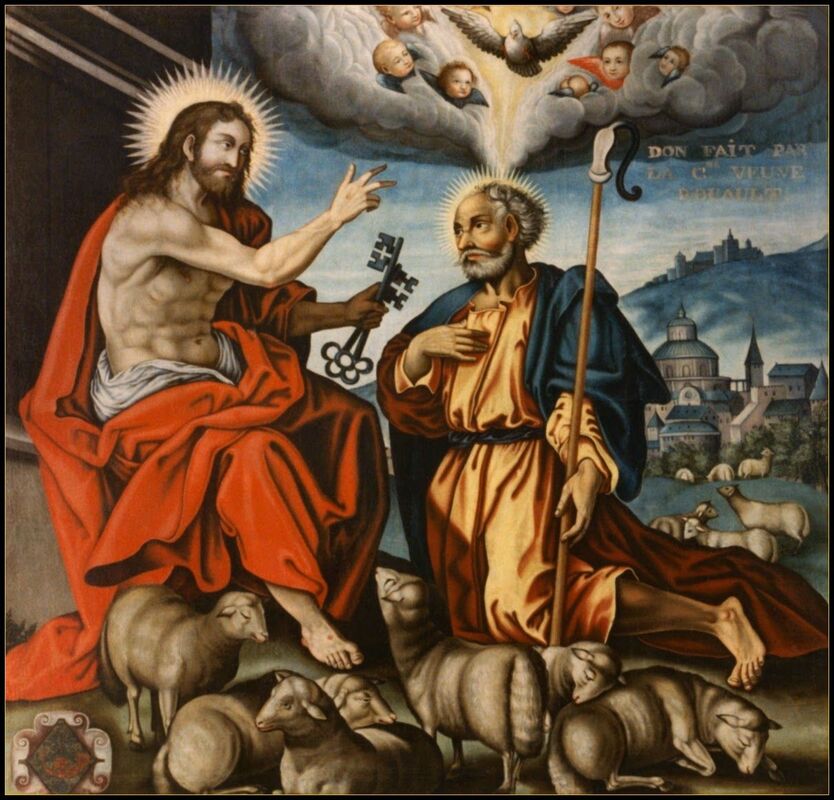
This is precisely, in Guardini’s view, the role of the Church. The Church exists to bridge the gap between the impossibility of the Christian life and what man is capable of accomplishing in the here and now. The Church, the Bride of Christ, is to act as a mother. It is her role to raise them, to teach them right from wrong, to pick them up when they fall, and to push them to be more than they ever thought they could be. She is what Christ has given to us, so that we might become what he desires for us. This isn’t to say the Church doesn’t have limitations. Certainly she does. All kinds of evils can be found within the Church: tyranny, greed, intolerance, or any other manner of evil. “All these are simply improper, and we shall have to answer for them before God.” Her mission is clear: to act as the mediator between the possible and the impossible. That fact alone has dangers. Man could begin to elevate the mediator to the level of God—that is, man could begin mistaking, for example, practical guidance from the Church to be prescriptive divine command. As Catholics we are all too familiar with this danger, as there is no shortage of confusion amongst the laity regarding the levels of magisterial teaching. The dangers are clearly on both fronts here, both on the side of the individual and on the side of the Church. Nevertheless, Christ has given us the Church, and has sent the Holy Spirit to guide her and us. We should be conscious of the dangers, certainly. But if we approach the tasks set forth to us in faith, and if we truly have faith that the Holy Spirit does, indeed, act as our advocate and helper in all things, we will find that despite all our failings the impossible can become the possible.
0 Comments
Leave a Reply. |
Series Info
Every day of Lent, I am writing a reflection piece on two chapters of "The Lord" by Romano Guardini. If you'd like to read or follow along, you can find the full calendar of where we're at below, or Click Here for the main landing page. Archives
April 2020
Categories
All
|
 RSS Feed